For about a year now, I've (re)discovered something. That's playing (board) games. Except I'm not talking about a round of Monopoly or Stratego, I'm talking about (board) games that are classified as expert or connoisseur level. These are games with more depth than your everyday games, that require more thinking, and where your entire table is quickly covered when you play them.
This is also my first blog in hopefully a series, about board games that come with a certain amount of complexity. I'd like to start with the most approachable game, Forrest Shuffle. Discover a tactical card game where you create your own forest.
Forrest Shuffle in a nutshell
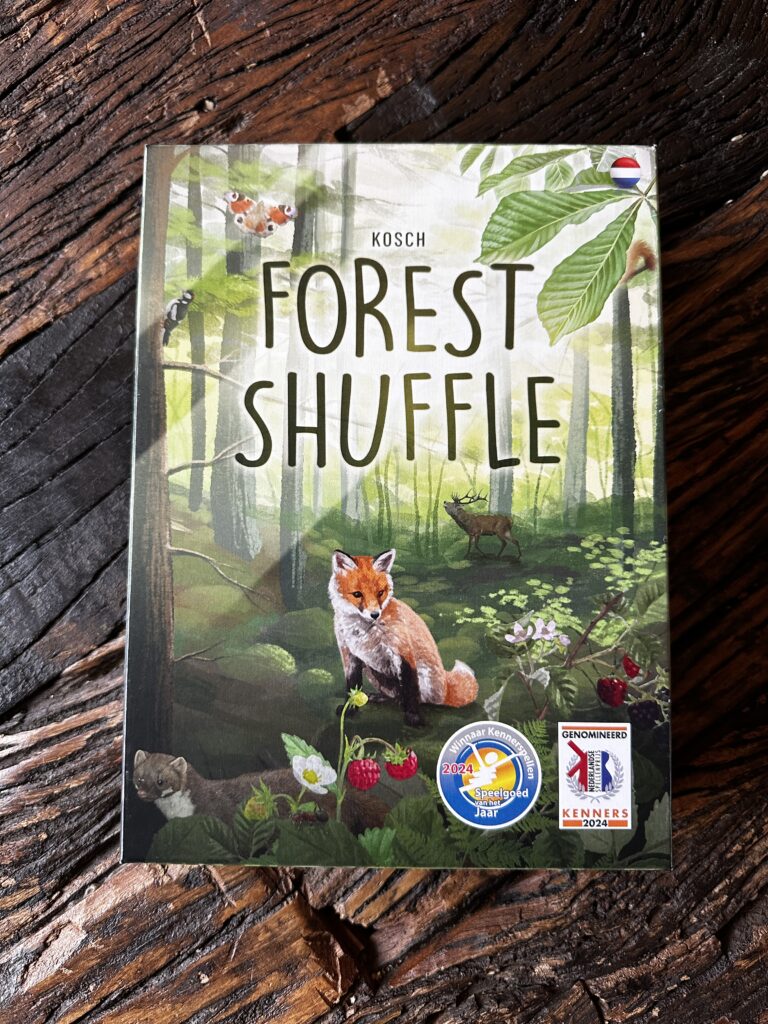
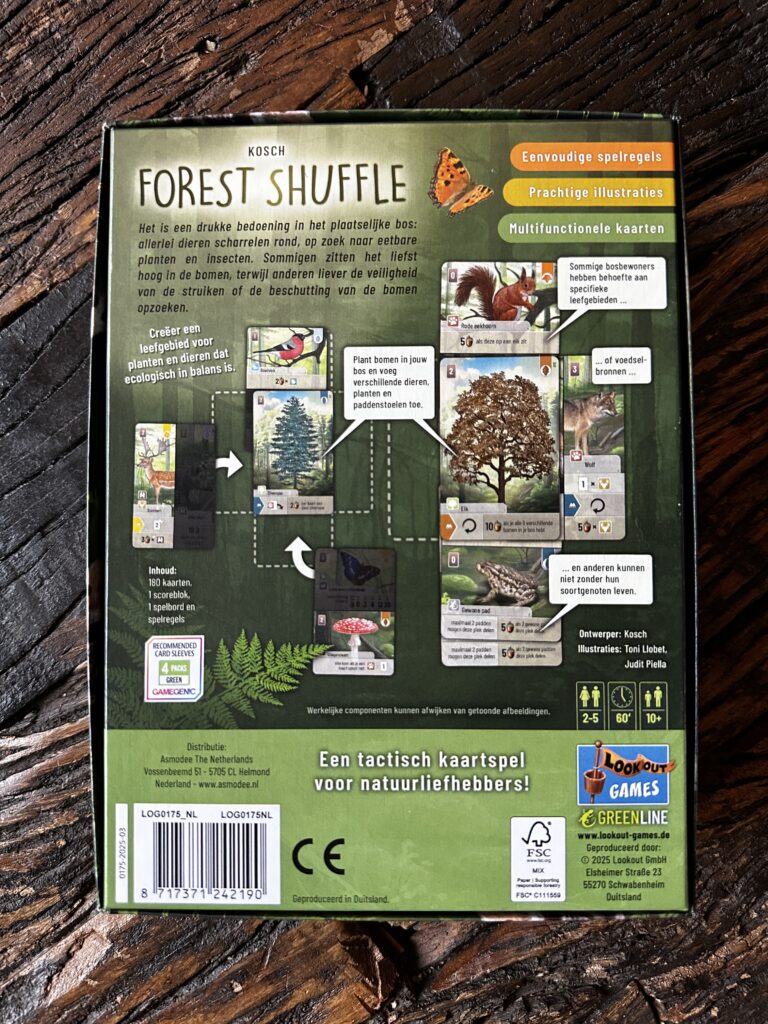
Let's start with the box. The box is just a bit bigger than A5 size and also fairly flat. It mostly contains cards, a slim game board, a manual and a score pad. It's a handy game to take on holiday. You play the game with two to ten people, a round of Forrest Shuffle takes about an hour, and the recommended age is 10 and up.
With Forrest Shuffle the goal is to create your own forest with as optimal an ecosystem as possible (yay, points). You do this by drawing cards, playing cards, and paying for the cards you play with cards from your hand. Every round you're making choices. Which plant or animal is the most efficient for my forest? The cards are beautifully designed and the rules are explained in a compact, quick way.
What's in the Forrest Shuffle box
In the box you'll find: 180 cards, of which 66 are trees, 48 cards with forest creatures on top and bottom, 44 cards with forest creatures on the left and right, 3 winter cards (essential for ending the game), a game board (The Clearing), 14 reference cards (rules per card), 5 caves and a score pad. At first you think, hm, a nice manageable and handy game! We can easily play this on a terrace. Well, that depends a bit on how big you make your forest. There's actually no maximum to the number of trees you're allowed to play in your forest.
The game board; The Clearing
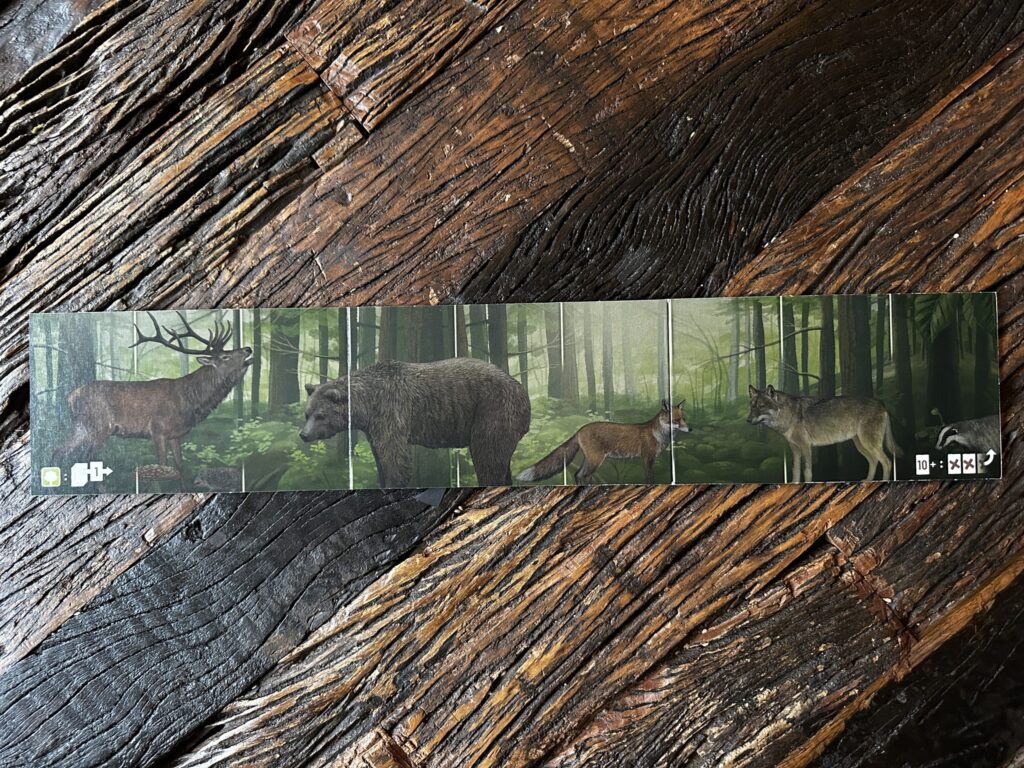
To the left of the beautifully illustrated game board, you place the face-down draw pile. This is the pile you get to take cards from when you perform the 'draw two cards' action. On the game board, the Clearing, a maximum of 10 cards may lie. Once that maximum is reached, those cards need to be removed and moved to the discard pile.
So how do those 10 cards end up there in the first place? When you play a card and pay its cost, you pay with the indicated number of cards. You place those cards on the Clearing.
When you perform the 'draw two cards' action, you're also allowed to take cards from the Clearing.
The playing cards
Let me be clear, I'm really not going to go through every single card and tell you everything you could do with it and what the best tactic is for each one. What I'd rather do is give you a general sense of what each category of cards is for and what to pay attention to when you play a given card.
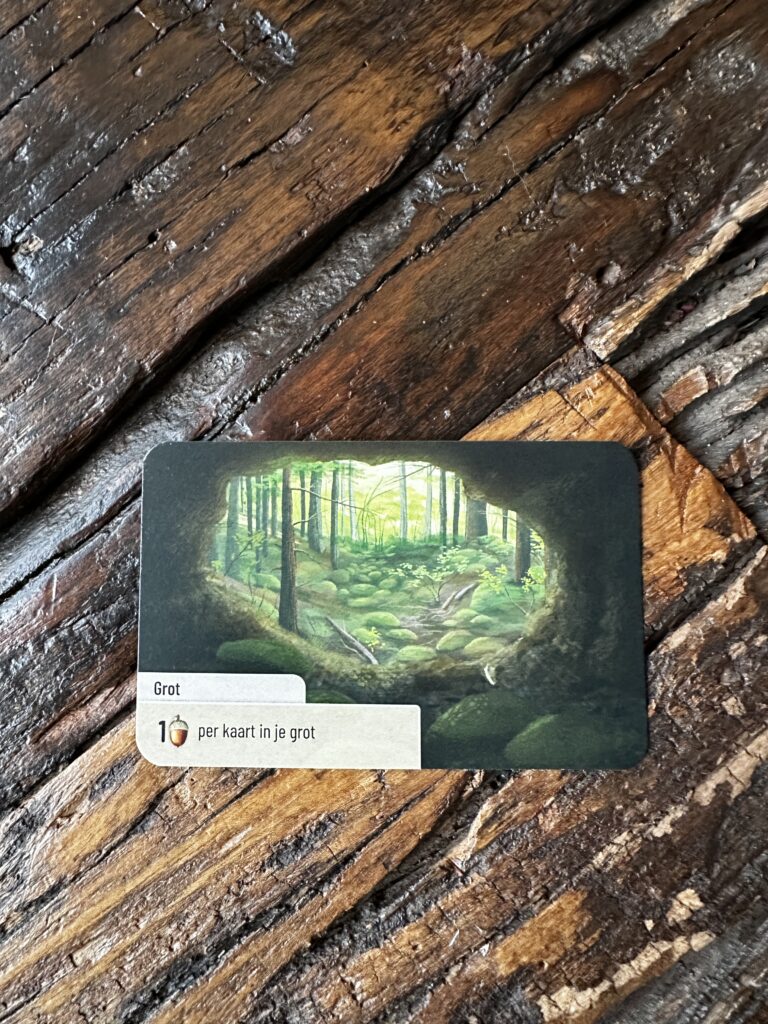
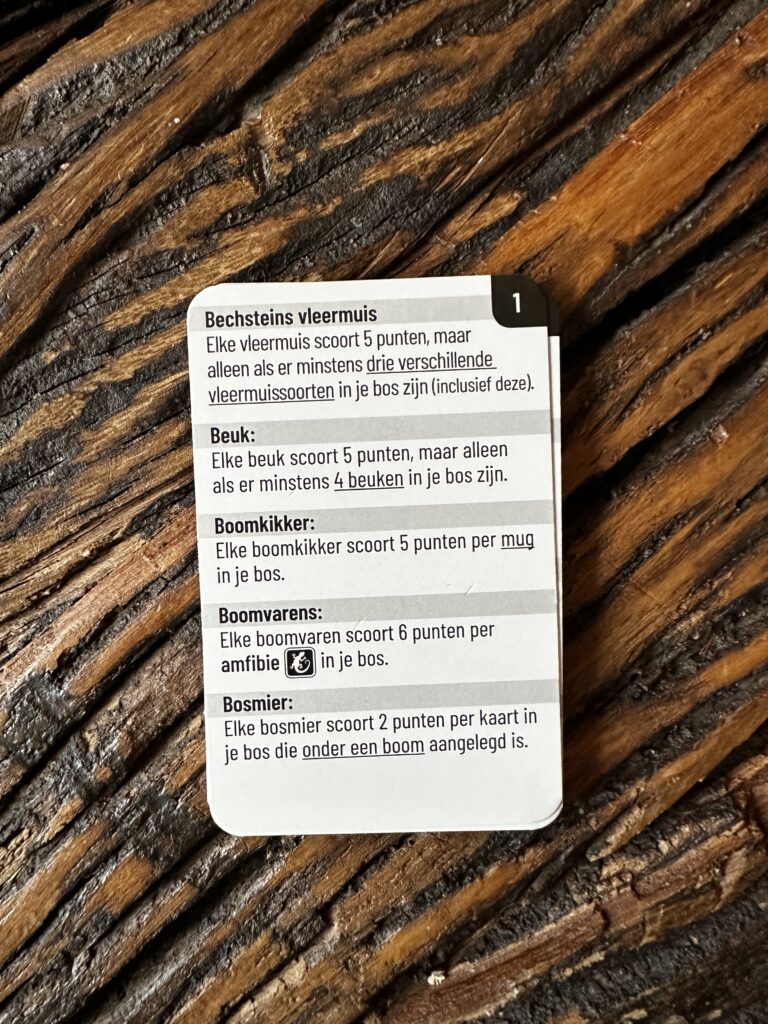
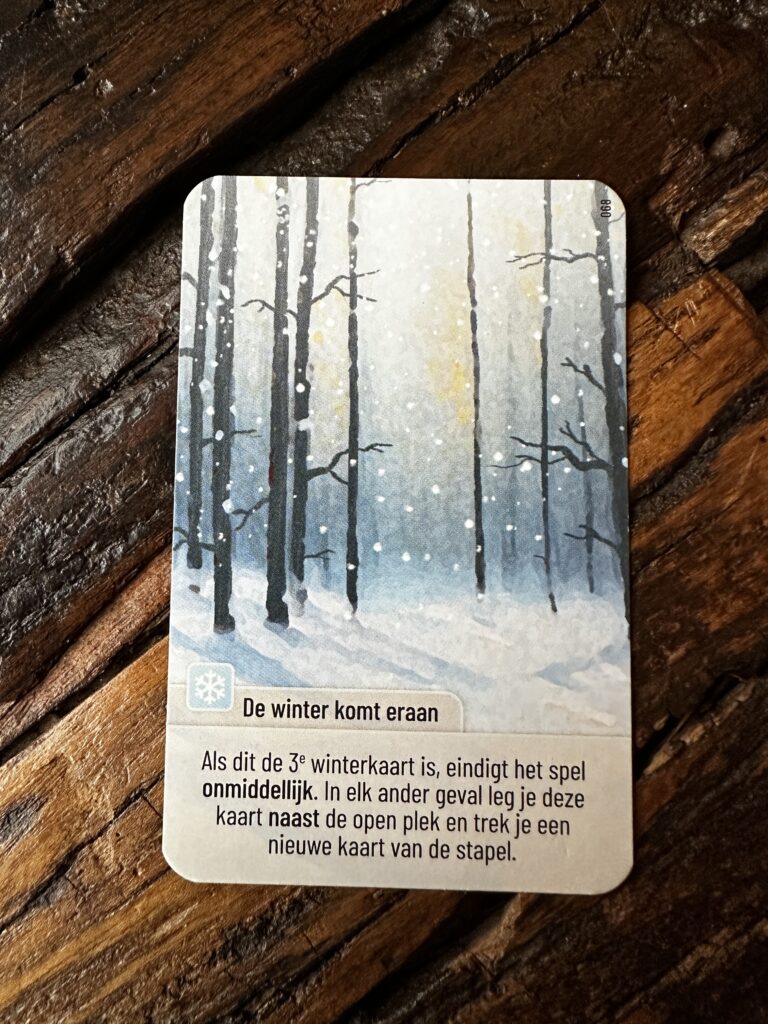
The caves: Every player has a cave. On some cards you play, you can activate a bonus action that lets you discard cards into your cave. Every card in this cave is worth one point.
The reference cards: These briefly describe the scoring rules for each animal, insect, plant, etc. at the final point count.
The winter cards: There are three winter cards in total. You shuffle these into the bottom 1/3 of the draw pile. The first two cards you draw from the draw pile (by which point you're already roughly 2/3 of the way through the cards) are a warning. The end of the game is approaching. When the third winter card is drawn, the game ends immediately. No one may perform any more actions.
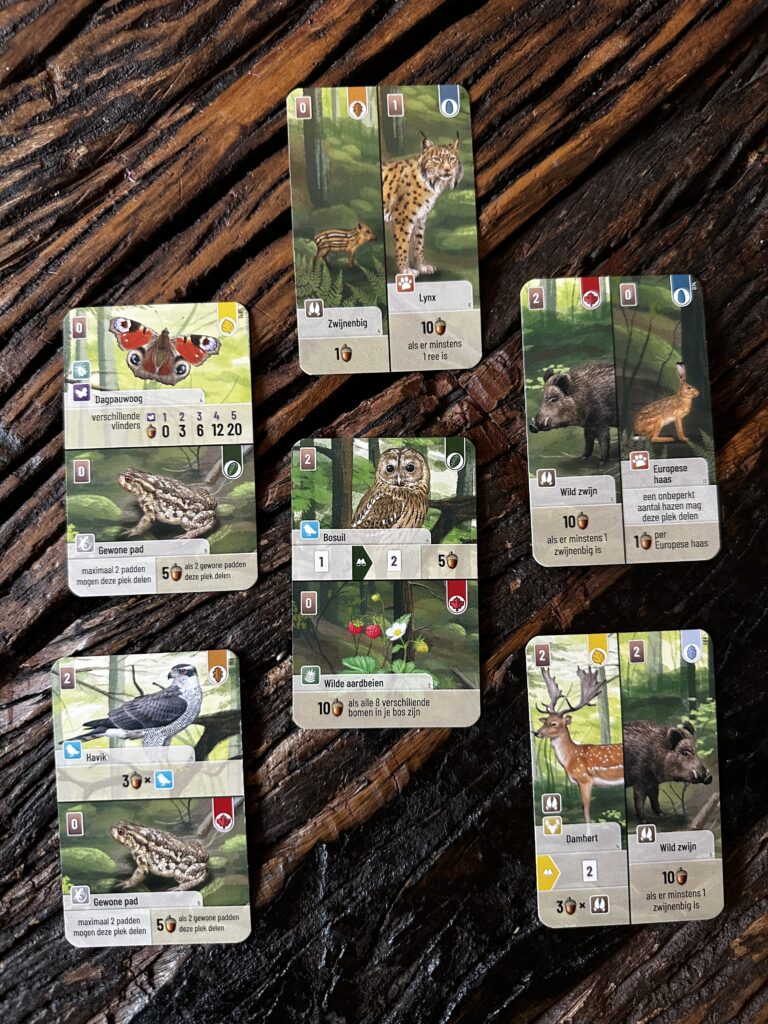
The forest creatures that can be placed above or below the tree: There are 48 of these cards in total, if you only own the base game. You play this card by placing the forest creature above or below your played tree.
The forest creatures that can be placed left or right of the tree: There are 44 of these cards in total, if you only own the base game. You play this card by placing the forest creature left or right of your played tree.
A closer look at a Forrest Shuffle forest creature card, top/bottom
Let's take a closer look at a card like this. What's on it and what should you pay attention to? I performed the 'draw two cards' action and now have this card in my hand. This card can be used in three ways: playing the Peacock Butterfly, playing the Common Toad, or using it to pay for another forest creature. In this situation, let's assume I'm deciding whether I want to place the butterfly next to my tree, or the toad.
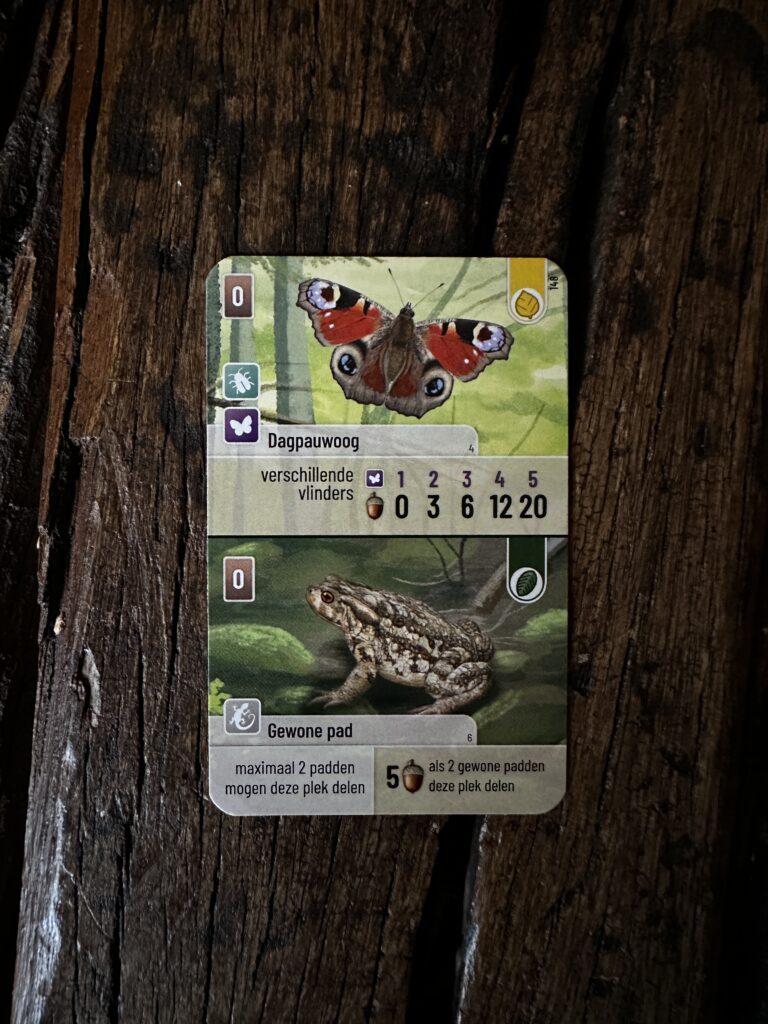
With both images on the card, there's a brown rectangle in the top left with the white number 0 in it. This means the cost of playing the butterfly is free, and the same goes for the toad.
Above both images on the top right is a colored tree leaf, these are the tree symbols. For the butterfly (yellow) the Linden leaf is shown, and for the toad (dark green) the Beech leaf is shown.
For the butterfly and the toad, to the left of the name, are the species symbols. Next to Peacock Butterfly there are two symbols; insect and butterfly. For the toad, this is only the symbol for amphibian.
The scoring
Below the images is additional information, in this case it's only about the scoring. How do you count the points of the Peacock Butterfly at the end of the game? You can find this on the reference cards: Butterflies are scored as a set: 1/2/3/4/5 different butterfly species in your forest score 0/3/6/12/20 points. You can have multiple sets, but each card can only be part of one set. Okay, okay, let's say, I have one set of three different butterflies, then every butterfly in that set is worth 6 points. Besides that set, I also have a set of two different butterflies, then every butterfly in that set is worth 3 points.
How do you count the points for the Common Toad? May share the tree's card space with a maximum of one other Common Toad. Each Common Toad scores 5 points, but only if it shares the card space with another Common Toad. Sooo, I get a total of 10 points, but then I do need to have two Common Toads stacked on top of each other under the same tree.
A closer look at a Forrest Shuffle forest creature card, left/right
Let's take a closer look at a card like this. What's on it and what should you pay attention to? I performed the 'draw two cards' action and now have this card in my hand. This card can be used in three ways: playing the Fallow Deer, playing the Wild Boar, or using it to pay for another forest creature. In this situation, let's assume I'm deciding whether I want to place the deer next to my tree, or the boar.
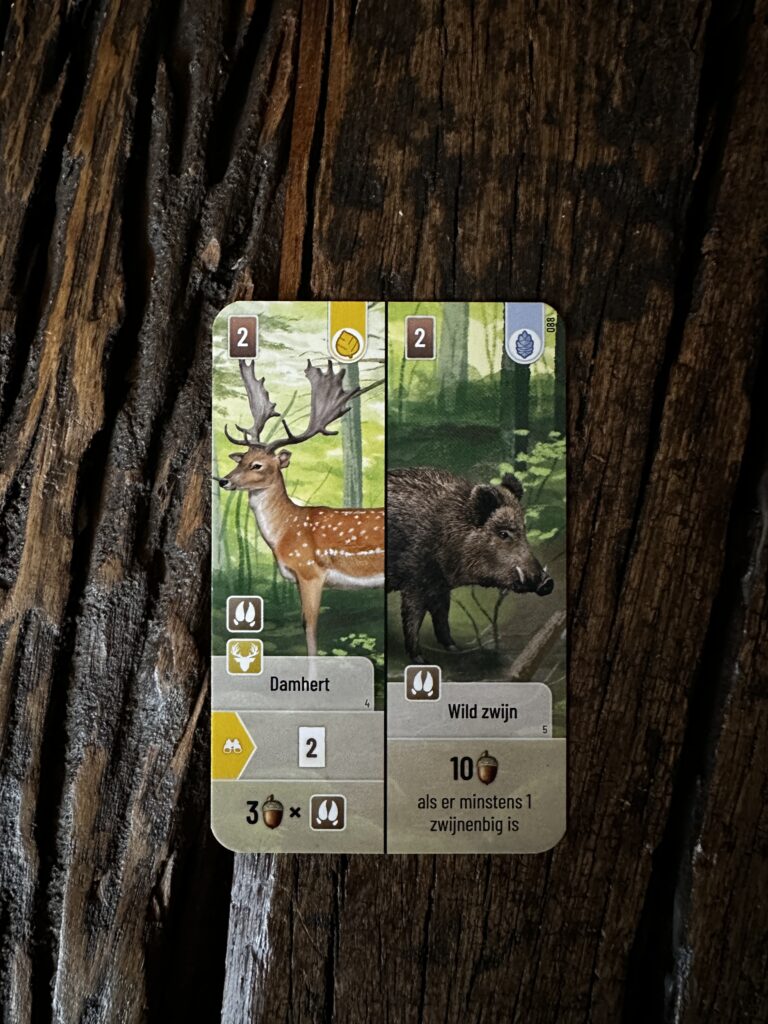
With both images on the card, there's a brown rectangle in the top left with the white number 2 in it. This means the cost of playing the deer is two cards. The same goes for the boar.
Above both images on the top right is a colored tree leaf, these are the tree symbols. For the deer (yellow) the Linden leaf is shown, and for the boar (grey) the Douglas Fir is shown.
For the deer and the boar, to the left of the name, are the species symbols. Next to the deer there are two symbols, and they mean: even-toed ungulate and deer. For the boar, only the symbol for even-toed ungulate is shown.
There's something new with the Fallow Deer. Underneath the name, we see the symbol of a pair of binoculars in yellow. This means that when playing the Fallow Deer, you can unlock a bonus. How do you do that with the Fallow Deer? The yellow color indicates that you can pay the cost of the fallow deer with forest creatures that have the Linden leaf as their tree symbol. So, do you pay with two forest creatures that have a Linden leaf as their tree symbol? Then you unlock the bonus. What is that bonus? In the case of the Fallow Deer; draw two extra cards when you play this Fallow Deer and pay with the correct color of tree symbols.
The scoring
Below the images is additional information, in this case it's only about the scoring. How do you count the points of the Fallow Deer at the end of the game? You can find this on the reference cards: Each fallow deer scores 3 points per even-toed ungulate in your forest (including the fallow deer itself). I think that pretty much speaks for itself.
Then for the Wild Boar. Each wild boar scores 10 points, but only if you have at least 1 boar piglet in your forest. (Multiple boars may use the same boar piglet as a scoring condition). Fine, so I also need to have a Boar Piglet somewhere in my forest. If I have one, I can put an unlimited number of boars in my forest and each one will earn 10 points.
A complete tree in Forrest Shuffle
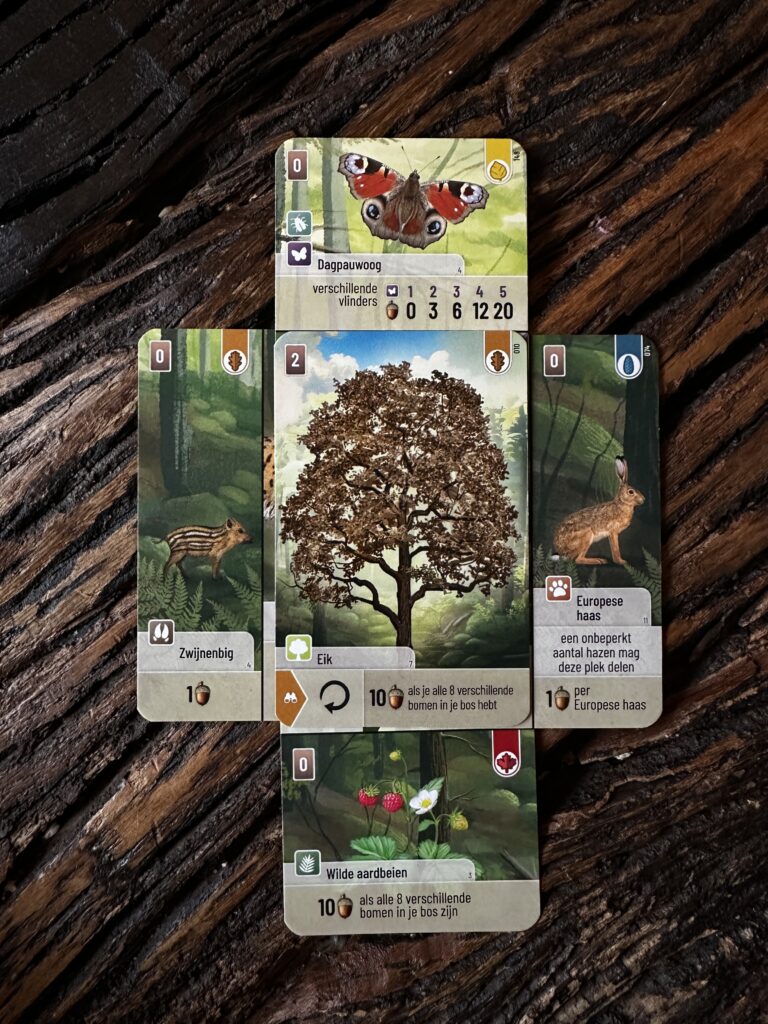
What do you see here?
Oak: That's a tree card. This card was paid for with two other cards. If it was paid for with two cards that have an Oak leaf as their tree symbol, the forest is unlocked. What's the bonus? Take another full turn after this one. For scoring, you get 10 points if you have all eight different trees in your forest.
Peacock Butterfly: This is a forest creature you can place above, a butterfly, so an insect. You play this card for free. The points depend on the other butterflies in your forest.
Wild Strawberry: This is a plant that costs you nothing. For this card too, you only get points if you have all the different trees in your forest.
Boar Piglet: An odd-toed animal, which costs no cards. Not an exciting card, you get one point for it. This card is very important though, when you have one or more wild boars in your forest.
The European Hare: Also a card with no cost. It's a paw animal, and you're allowed to stack as many hares as you like in one spot in your forest. Each hare then earns one point.
Wrapping up
Once you've set everything up so you can begin, you start playing in turns. The game board lies out empty, to the left of it the face-down draw pile with the three winter cards shuffled in, every player has a cave in their forest, and every player starts with six cards from the draw pile. There must be at least one tree among them. If there isn't? You return all six cards and get one re-draw.
After that, you start playing. You choose between the two actions: Draw two cards, or play a card. When drawing cards, you may draw cards from the face-down draw pile and from the Clearing. When playing cards, you may only play a card from your hand. So this can be a tree card or a forest creature card. You check whether there's possibly a bonus action tied to the card you played. When you play a tree, you draw a card from the draw pile each time and place it face up on the Clearing. This way you keep track of whether there are already a maximum of 10 cards on the Clearing. By the way, you're also only allowed to have a maximum of 10 cards in your hand.
As soon as all three winter cards have been drawn, the game is over and it's time to count points!
Forrest Shuffle is available from several retailers. The price currently, as of November 2025, ranges between 20 and 30 euros. Can't get enough of this card game? Then there are also several expansions available, such as the Alpine expansion.
Enjoy playing <3